[Editor’s Note: As we saw in Dr. John Ringquist‘s informative post last year, “China is building dossiers on virtually every U.S. citizen and is harnessing AI to correlate sensitive information across databases they have stolen over the years from the U.S. Office of Personal Management (OPM), health insurers, and banks — this data includes fingerprints, foreign contacts, financial debts,  and personal medical records. With this granular-level of understanding, the PLA can craft precise influence operations at machine speed — tailored to target key demographics and even specific individuals to shape U.S. domestic perceptions in favor of the CCP’s strategic objectives. “China’s cognitive warfare against the United States is happening now.”
Today’s submission by proclaimed Mad Scientist Dr. James Giordano continues to explore this thread, addressing how China plans to conduct operations in the cognitive domain to further its strategic objectives. The implications for the Joint Force and U.S. Army could not be more succinct — recognition that the “cognitive domain has become a primary contested element of [China’s] MPW [Multi-domain Precision Warfare]… [necessitating] dedicated efforts in developing cognitive warfare doctrine; new, effective methods and tools for detection, deterrence and defense against cognitive engagement(s); and revised training to foster personnel and systemic Joint Force capability in this space” — Read on!]
“The skillful leader subdues the enemy’s troops without fighting; captures their cities without laying siege to them; overthrows their kingdom without lengthy operations in the field.” — Sun Tzu, The Art of War
Consider this FICINT scenario: The year is 2027. A crisis erupts over Taiwan. As tensions fester, INDO-PACOM personnel experience a wave of cascading “micro-disruptions”: GPS anomalies in the Philippine Sea that hamper maritime operations; variably inaccurate logistics data at Anderson AFB, 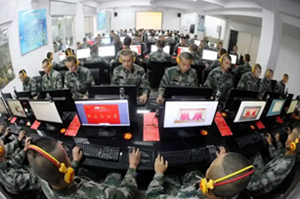 Guam; and a tsunami of deepfake videos showing U.S. military commanders making inflammatory statements about allied populations. Concomitantly, Taiwan’s civil infrastructure is assailed by coordinated cyberattacks, and Taiwan’s citizens’ social media platforms are flooded with narratives of American abandonment and the inevitability of PRC hegemony. Not a conventional round has been fired, and yet China has achieved tactical advantage toward gaining strategic dominance.
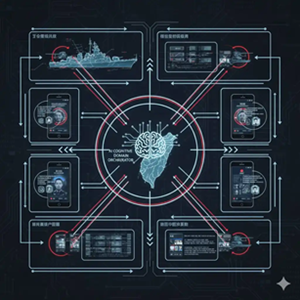 This is Multi-domain Precision Warfare (MPW) — the operational realization of China’s intelligentized People’s Liberation Army (PLA). Unlike traditional combined arms operations, MPW engages the cognitive domain as a primary battlespace and weaponizes psychological and social factors to evoke disruptions in target populations’ ideas, beliefs, values, decisions and behaviors. In the MPW model, Artificial Intelligence (AI)-enabled systems are not just force multipliers of kinetic engagement but rather are employed to orchestrate and execute influence campaigns that disrupt decision-making capacity, alliance cohesion, and the information environment in ways that render kinetic force either unnecessary, or make it devastatingly effective yet employable with considerable economy.
 The PLA’s intelligentization doctrine should be seen as a reconceptualization of warfare’s locus of control that now focuses upon the thoughts, feelings, and behaviors of the human elements that are targeted. By integrating AI-based cognitive operations with electromagnetic, cyber, and kinetic capabilities, the PLA aims to achieve “decision dominance” by manipulating, disrupting, and directing adversary perception, cognition, and will, without — or at least in advance of — conventional military engagement.
The implications for INDO-PACOM are significant. MPW poses a clear and present threat, as the PLA is investing heavily in the neurocognitive sciences,  AI-driven behavioral prediction, and dual-use neurotechnologies. The PLA need not engage INDO-PACOM kinetically if it can induce tactical confusion, multidimensional disruption, and strategic paralysis through cognitive manipulation, alliance fragmentation, and decision-space compression. Thus, U.S. Joint Forces cannot risk assuming resistance or resilience to MPW that they do not yet possess.
U.S. Joint Force preparedness will certainly require technological counter-measures; but these alone are insufficient. What is needed is a frank acknowledgment that the cognitive domain has become a primary contested element of MPW, and from this recognition, should follow dedicated efforts in  developing cognitive warfare doctrine; new, effective methods and tools for detection, deterrence and defense against cognitive engagement(s); and revised training to foster personnel and systemic Joint Force capability in this space. At this point, the question is no longer whether an intelligentized PLA can execute MPW, but if, and to what extent U.S. Joint Forces are ready to engage in and win decisively in this new cognitive battlespace.
 If you enjoyed this post, check out the T2COM G-2‘s Operational Environment Enterprise web page, brimming with authoritative information on the Operational Environment and how our adversaries fight, including:
Our T2COM OE Threat Assessment 1.0, The Operational Environment 2024-2034: Large-Scale Combat Operations
Our China Landing Zone, full of information regarding our pacing challenge, including ATP 7-100.3, Chinese Tactics, T2COM OE Threat Assessment 1-1, How China Fights in Large-Scale Combat Operations, 10 Things You Didn’t Know About the PLA, and BiteSize China weekly topics.
Our Russia Landing Zone, including T2COM OE Threat Assessment 1-2, How Russia Fights in Large-Scale Combat Operations and the BiteSize Russia weekly topics. If you have a CAC, you’ll be especially interested in reviewing our weekly RUS-UKR Conflict Running Estimates and associated Narratives, capturing what we learned about the contemporary Russian way of war in Ukraine in 2022 and 2023 and the ramifications for U.S. Army modernization across DOTMLPF-P.
Our Iran Landing Zone, including the Iran Quick Reference Guide and the Iran Passive Defense Manual (both require a CAC to access).
Our North Korea Landing Zone, including Resources for Studying North Korea, Instruments of Chinese Military Influence in North Korea, and Instruments of Russian Military Influence in North Korea.
Our Irregular Threats Landing Zone, including TC 7-100.3, Irregular Opposing Forces, and ATP 3-37.2, Antiterrorism (requires a CAC to access).
Our Running Estimates SharePoint site (also requires a CAC to access) — documenting what we’re learning about the evolving OE (including Russia’s war in Ukraine war since 2024 and other ongoing competitions and conflicts around the globe). Contains our monthly OE Running Estimates, associated Narratives, and the quarterly OE Assessment Intelligence Posts.
Then review the following related Mad Scientist Laboratory content:
Challenging Reality: Chinese Cognitive Warfare and the Fight to Hack Your Brain, by Dr. John Ringquist
“Intelligentization” and a Chinese Vision of Future War
China and Russia: Achieving Decision Dominance and Information Advantage, by Ian Sullivan
Winning the Future: The U.S. Military’s Need for Technological Dominance and Defined Strategic Vision, by Dr. James Giordano and Elise Annett
China’s Brain Trust: Will the U.S. Have the Nerve to Compete? by Dr. James Giordano, as well as his Neuroscience, Neurotechnology, and the Future of War and Neuroscience and the Weapons of War podcasts, hosted by our colleagues at the Modern Warfare Institute
Linking Brains to Machines, and Use of Neurotechnology to the Cultural and Ethical Perspectives of the Current Global Stage and Designer Genes: Made in China? by Dr. James Giordano and Joseph DeFranco
Sub-threshold Maneuver and the Flanking of U.S. National Security and Is Ours a Nation at War? U.S. National Security in an Evolved — and Evolving — Operational Environment, by Dr. Russell Glenn
The Erosion of National Will – Implications for the Future Strategist, by Dr. Nick Marsella
A House Divided: Microtargeting and the next Great American Threat, by 1LT Carlin Keally
Weaponized Information: What We’ve Learned So Far…, Insights from the Mad Scientist Weaponized Information Series of Virtual Events, and all of this series’ associated content and videos
Weaponized Information: One Possible Vignette and Three Best Information Warfare Vignettes
 >>>Reminder 1: Mark your calendars now — the Army Mad Scientist / William & Mary Great Power Competition & Conflict in an Age of Authoritarian Collusion Virtual Event is next Tuesday, 27JAN26:
Who: The Army Mad Scientist Initiative and William & Mary’s Whole of Government Center of Excellence
What: A virtual event exploring the Operational Environment implications of emerging trends gleaned from contemporary conflicts and proxy wars, as well as the expanding adversarial influence and presence in the Global South and polar regions, through the lens of authoritarian collusion
When: Tuesday, 27 January 2026
Where: Virtual via Zoom.gov; in-person on campus for local T2COM G-2 and FCC participants
Why: To learn from subject matter experts within academia and the Department of War about the implications of authoritarian collusion, ultimately expanding our understanding of the Operational Environment
Check out the agenda here, then register to attend this informative event virtually at our EventBrite site.
 >>>Reminder 2: Army Mad Scientist is CALLING ALL CREATORS with our Multi-Media Contest for imaginative thinkers who seek to showcase their ideas about Army Transformation in novel, alternative ways. Check out the contest’s guidelines here, consult your inner muse, unleash your creative talent, get cracking developing your entry, and submit it to ArmyMadSci@gmail.com — Deadline for submission is 14 February 2026!
About the Author: Dr. James Giordano is Director of the Center for Disruptive Technology and Future Warfare of the Institute for National Strategic Studies at the National Defense University.
Disclaimer: The views expressed in this blog post are those of the author and do not necessarily reflect those of the U.S. Department of War, Department of the Army, the Transformation and Training Command (T2COM), or the National Defense University.